Decorating Floating Shelves for Christmas Without Exceeding Their Weight Limit
October 08, 2026 - Home Decor
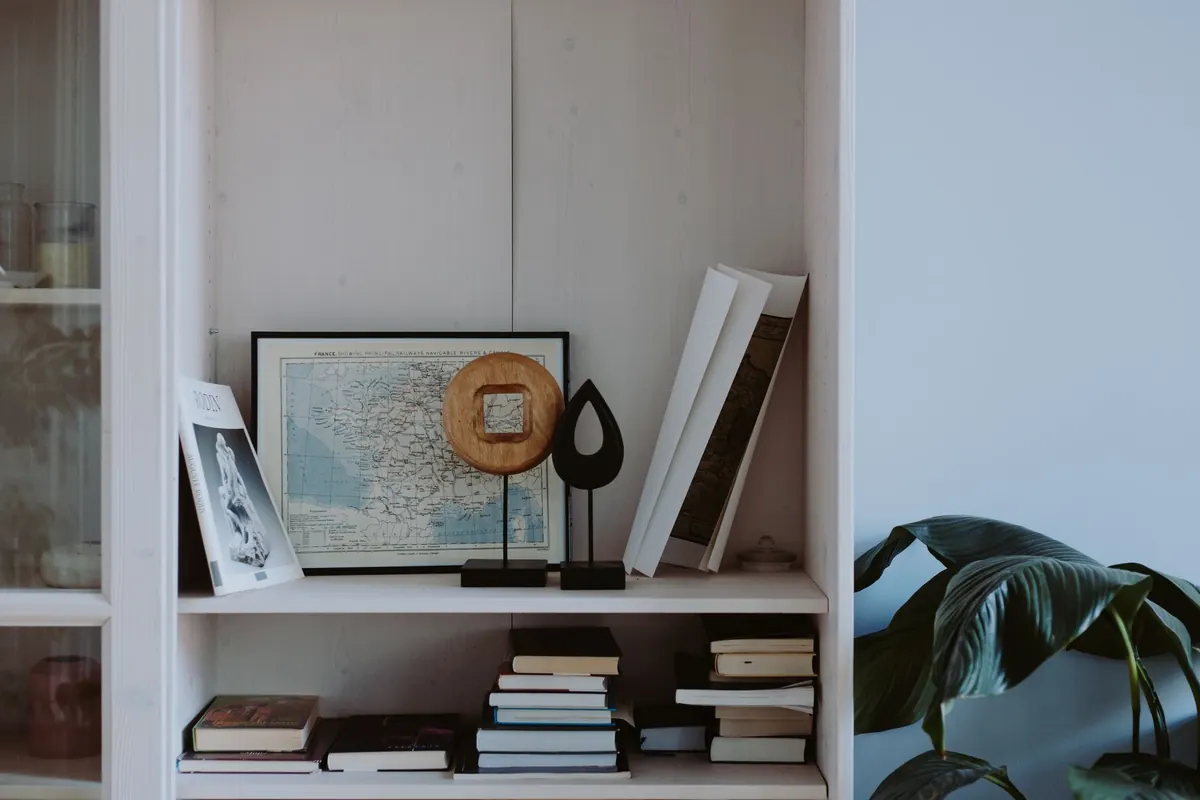
Most bookcases don't look cluttered because they hold too many books. They look cluttered because every shelf is shouting at the same volume, with the same gap above the books and the same tight run from side to side. Change the spacing and the whole unit settles down, often without giving away a single volume. Here are the mistakes that cause most of the trouble, and what to do instead.
Most shelving comes with holes drilled at regular intervals, so it's easy to leave them evenly spaced and never think about it again. The result is a bookcase that looks like a spreadsheet: paperbacks floating in a 30cm cavern, a tall art book wedged in sideways because it won't stand up.
Set each shelf to the books it will hold. Measure your tallest book, add a couple of centimetres of air, and move the pins to suit.
Then group books by height so each shelf fills to a similar line. Two or three different shelf heights across a tall unit reads as designed. Six different heights reads as an accident.
A row packed hard from one side to the other has no punctuation. The eye runs along it, hits the side panel and moves on — that's the feeling people describe as busy.
Leave a gap at the end of each row. A gap the width of your hand is enough, and a gap the width of a paperback takes the pressure off the whole unit. It also gives you somewhere to put a book you're currently reading, or a small object, without disturbing the rest.
If there isn't a hand's width of space anywhere, you're not choosing what's on the shelf, you're just accommodating it. Take out the books you won't read again, the duplicates, and the ones you keep out of guilt.
Depth is the mistake people notice without being able to name. Books shoved to the back of a deep shelf leave a dark void in front of every spine and the shelf looks like a tunnel. Books pulled forward on a shallow or overhanging shelf look as though they're about to fall.
Pick a line and keep it. The simplest is to set the front of the books flush with the front edge of the shelf, or a centimetre or two behind. Do that consistently across the unit and it instantly looks intentional.
If your shelves are deeper than your books, make a decision: either accept the extra depth and dress it deliberately, with small objects in front or a shallow display of magazines, or claim the back section for things you don't need to see — boxes, folders, out-of-season items. What you don't want is a random mix, where some books sit forward and some sit back, so the shelf looks half-empty by accident.
A shelf looks calm when the eye has somewhere to stop. Depth, gaps and height changes are simply places to stop.
Books held upright only by friction will lean. Leaning books pull the row out of line, and a row out of line makes everything around it look messy.
Use bookends. On a wooden shelf, simple L-shaped ones with a felt base do the job. If you'd rather not see the bookend, use a stack of two or three heavy books at the end of the row as a stopper.
Horizontal stacks are one of the best tools you have, but use them as punctuation rather than storage. A stack of three or four books with something small on top breaks up a wall of spines and gives the shelf structure. Six books lying flat in a wobbling tower is a different thing entirely.
Full shelves next to full shelves next to full shelves is visually exhausting. What you want is rhythm: a dense row, then a sparser one, then dense again.
You don't need to empty anything. You need to redistribute the empty space.
The top of a bookcase collects whatever doesn't have a home: post, cables, a half-finished jigsaw, a box that never got unpacked. Even a beautifully arranged unit reads as clutter if the surface above it is a jumble.
Decide what lives up there and stick to it. One or two items — a lamp, a plant, a framed picture resting against the wall — is plenty. If the top of your bookcase is the only flat surface in the room, that's a storage problem rather than a styling problem, and it's worth solving properly elsewhere.
If the whole thing feels overwhelming, don't start from scratch. Work on one shelf at a time.
Do one shelf a day for a week and you'll have a bookcase that looks considered rather than crammed. The books haven't changed. The spacing has.
Photo: cottonbro studio / Pexels
How to decorate floating shelves for Christmas safely: check the fixings, estimate a rough load per shelf, and...
Open shelving and closed cabinets suit different kitchens. This comparison looks at dust, grease, access and visual...
Copyright © 2026 Mesa Shelf. All Right Reserved.